
AI in Asset Management: 2026 Statistics That Hold Up
An audited reading of 2025–2026 AI adoption surveys, with sample sizes, fieldwork dates, measures, limitations, and no blended headline percentage.

Published August 24, 2026 · Updated August 30, 2026
In this article
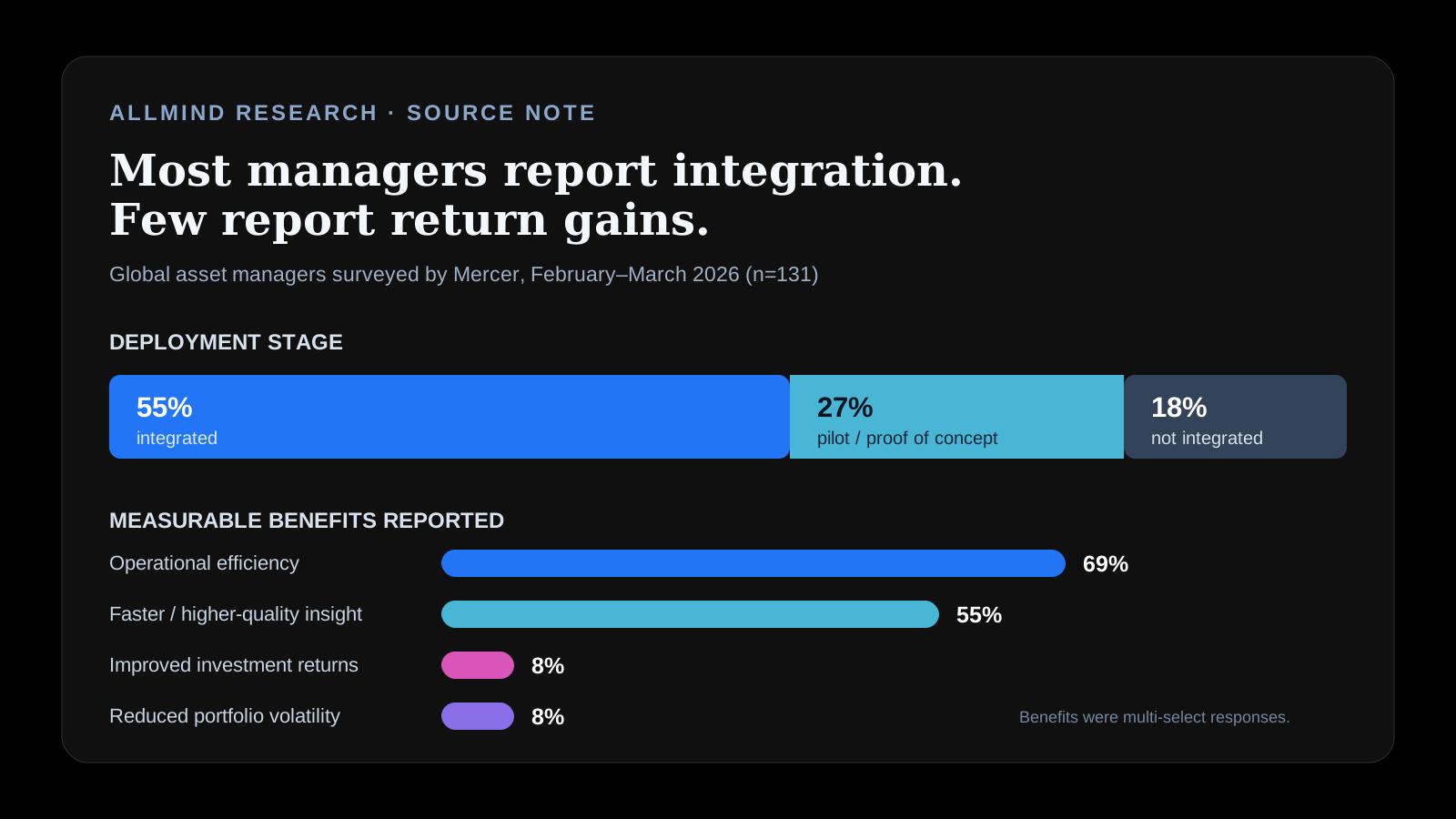
AI use is widespread in asset management, but there is no defensible single “2026 adoption rate.” AIMA found that 95% of 150 fund managers used generative AI somewhere in their work. Mercer found that 55% of 131 asset managers had integrated AI into at least one investment process, while 27% were still piloting it. Those results answer different questions. The most decision-relevant result is Mercer's: only 8% reported a measurable improvement in investment returns.
This is a public-source data note, not an AllMind customer study. We rechecked the original releases and regulator reports on August 30, 2026. The source table keeps each percentage beside its population, survey date, and exact measure so that “use,” “deployment,” and “outcome” do not collapse into one statistic.
The six sources worth keeping on one page
| Source | Population and fieldwork | What was measured | Result used here |
|---|---|---|---|
| AIMA, Charting the course | 150 global fund managers representing about $788 billion, plus 18 institutional investors; published September 16, 2025 | Any reported generative AI use and expected change in investment-process use | 95% used generative AI in their work; 58% expected more use in investment processes over the following year |
| Mercer, AI in asset management | 131 global asset managers; online survey in February and March 2026; published May 21, 2026 | Integration stage, use case, decision authority, benefits, and barriers | 55% integrated, 27% pilot, 18% not integrated; 5% granted decision authority; 8% reported improved returns |
| Substantive Research and Aiera | 35 of the largest global asset managers; published July 16, 2026 | Organization-wide general-platform deployment, data priorities, licensing, and onboarding | 77% had organization-wide deployments; 69% called licensing the largest direct-feed barrier; 37% reported four-to-six-month onboarding |
| AIMA and Marex, Emerging Manager Survey | 180 managers and 50 investors globally; published June 30, 2026 | Operating model and business-wide AI deployment among managers with up to $1 billion AUM | 42% of managers deployed AI across all business functions |
| Bank of England and FCA, 2024 AI survey | 118 UK-regulated financial firms across six sectors; published November 21, 2024 | AI use cases, automation, third parties, materiality, and governance | 75% used AI; 2% of use cases were fully autonomous; 84% of firms using AI named an accountable person |
| FINRA, 2026 Regulatory Oversight Report | Supervisory observations, not a survey | Common broker-dealer use cases and controls | Summarization and information extraction were the leading observed use case; FINRA calls for testing, logs, monitoring, and human review |
The first four rows describe different slices of investment management. The Bank of England and FCA row is a broader regulated-finance comparison, not an asset-management estimate. FINRA supplies supervisory context, not a prevalence rate.
Adoption, deployment, and outcomes are different measures
AIMA's 95% is the broadest definition: a respondent used generative AI somewhere in their work. It may describe an approved chat assistant, a back-office draft, or a front-office research task. Mercer asked a narrower question about investment-process integration. Its 55% integrated, 27% pilot, and 18% not integrated categories sum to the full 131-manager sample.
Substantive Research and Aiera measured something else again. Their 77% describes organization-wide deployments of general platforms such as ChatGPT or Claude at 35 very large managers. It does not mean that 77% had broker research, estimates, or internal models connected to those platforms. In the same survey, 69% named broker or data licensing as the largest barrier to direct feeds.
This distinction changes procurement conversations. A general assistant can satisfy “we use AI.” A research platform has to pass a harder test: can an analyst run a recurring process with licensed inputs, internal data, cited output, and an audit trail?
What asset managers report getting from AI
Mercer's benefit results are the cleanest current outcome measure because the same 131 managers answered the adoption and benefit questions:
| Self-reported benefit | Share of respondents | What it does and does not show |
|---|---|---|
| Enhanced operational efficiency | 69% | Managers perceive a process benefit; the release does not publish hours saved or audited cost reductions |
| Faster or higher-quality insights | 55% | Speed and quality are combined in one response, so the result cannot isolate either effect |
| Improved investment returns | 8% | A small minority report a measurable return effect; no common attribution method is disclosed |
| Reduced portfolio volatility | 8% | Self-reported effect; no common risk horizon or volatility definition is disclosed |
Two conclusions survive the caveats. First, operational value is being reported much more often than portfolio value. Second, the survey cannot tell a buyer how many analyst hours a particular product will save. Any “hours per analyst” claim needs its own sample, starting workflow, observation window, and calculation.
Decision authority is also narrow. Mercer reported that 5% granted AI autonomous or semi-autonomous authority for investment recommendations or trades. The Bank of England and FCA found that only 2% of AI use cases across UK financial services were fully autonomous. Those percentages use different denominators, but both argue against describing current adoption as autonomous portfolio management.
Hedge-fund numbers need their own denominator
The AIMA surveys are the strongest direct read on alternative fund managers. Its 2025 release says 95% of 150 managers used generative AI, up from 86% of 157 managers in the 2023 survey. AIMA also reports that the share expecting greater use in investment processes over the following year rose from 20% to 58%.
That is evidence of broader access and stronger intent. It is not a panel study of the same firms, and the wording moved from staff access in 2023 to reported use in 2025. The hedge-fund adoption analysis keeps that trend separate from Mercer's asset-manager integration stages.
AIMA and Marex provide a useful 2026 cross-check on smaller firms: 42% of 180 emerging managers reported deployment across all business functions. “Across all functions” is more demanding than “used somewhere,” so 42% and 95% can both be true.
A model benchmark is not an adoption statistic
Capability results often appear in the same decks as survey percentages, but they answer a different question. Vals Finance Agent v2 tests 927 expert-reviewed analyst questions with a common tool harness. Its August 19, 2026 leaderboard put the best model at 60.60% with partial credit and 50.88% under the stricter all-pass measure.
Deep FinResearch Bench, posted by JPMorganChase AI Research on April 22, 2026, compares agent-generated reports with 100 professional reports across 25 S&P 500 companies. The professional reports scored 2.84 on a four-point quality scale; the best agent scored 2.31. These results support rigorous review of AI output. They do not measure the adoption rate, realized return, or value of any commercial platform.
How to use the statistics in a 90-day evaluation
Turn the surveys into boundaries, then collect product-specific evidence from your own workflow:
- Name one integrated process. Mercer's 55% is the relevant baseline only if the tool enters a recurring investment process, such as an earnings review or coverage-list monitor.
- Separate operational and portfolio outcomes. Track elapsed time, analyst touch time, corrections, and source coverage. Do not claim return attribution from a 90-day trial when only 8% of managers in Mercer reported it at all.
- Test the data path in week one. The Substantive/Aiera survey shows why this matters: 69% named licensing as the largest direct-feed barrier, and 37% reported four-to-six-month onboarding.
- Keep a human approval point. FINRA's 2026 guidance emphasizes formal review, model and output monitoring, prompt/output logs, and human-in-the-loop validation.
- Write down the denominator. Report results as “17 of 20 earnings reviews completed with all figures cited,” not “85% accurate” without a task definition.
For a task-level companion, see equity research automation statistics. It turns these population studies into an evaluation worksheet without importing unsupported vendor time-saved claims.
How the six surveys were selected and normalized
We included a number only when the publisher supplied a primary release or paper, a population or denominator, and a date. We excluded repeated figures that could not be traced to an original report, figures quoted only by a software vendor about its own customers, and estimates that blended hedge funds, banks, wealth managers, and asset managers into one rate.
The remaining sources still have limits:
- The surveys are voluntary and self-reported. None is a census.
- Samples differ by firm type, size, geography, and wording. Percentages should not be averaged.
- AIMA's 18-investor subsample is too small to treat as a market-wide allocator estimate, so its investor-attitude percentages are not used here.
- Mercer publishes fieldwork timing and the sample but not respondent-level data or a common method for attributing returns.
- Substantive Research and Aiera cover 35 very large managers, which is useful for enterprise infrastructure decisions and not representative of the full industry.
- The 2024 Bank/FCA results predate the 2025–2026 fund-manager surveys and span regulated financial services, so they appear only as governance context.
The practical reading is conservative: access to AI is common; integration into a live investment process is lower; autonomous authority and measured portfolio outcomes are rarer still.