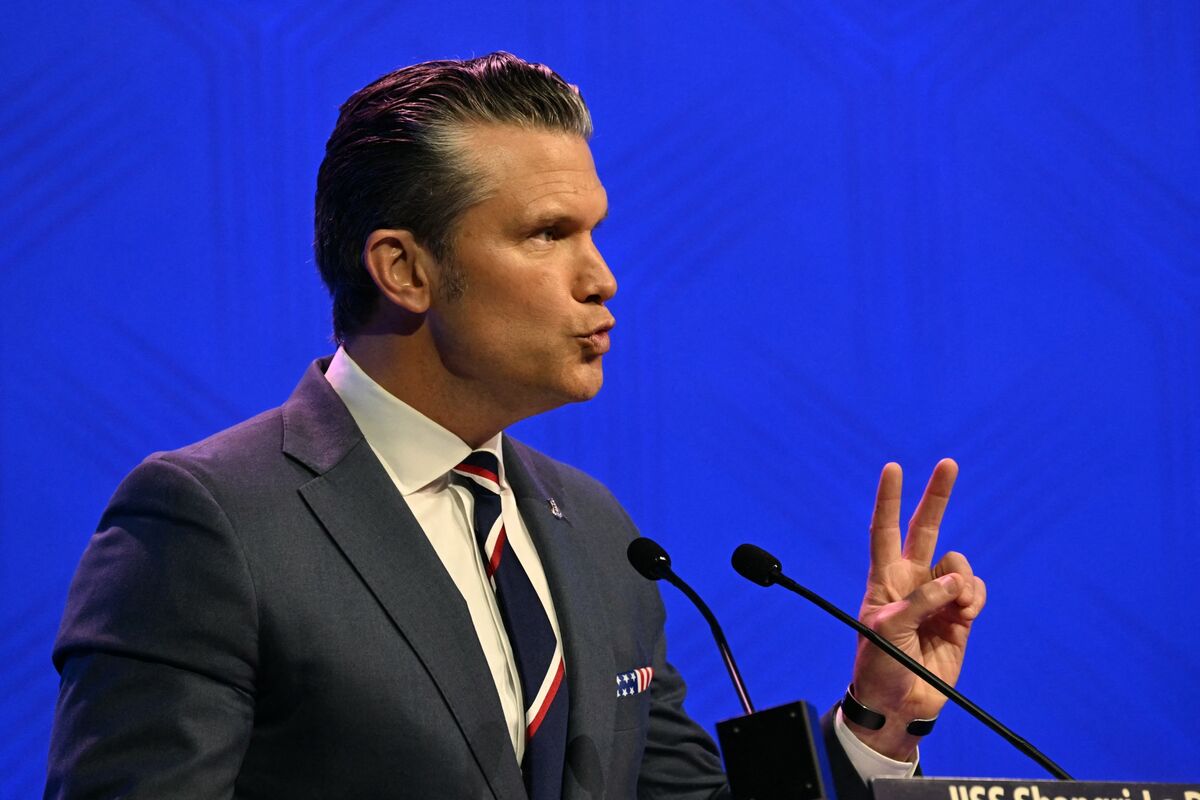
Defense Secretary Pete Hegseth said the Trump administration will prioritize "model allies" in Asia at the Shangri-La Dialogue in Singapore, while criticizing European defense partners. The remarks reinforce a more selective U.S. alliance posture and underscore continued strategic focus on Asia and China. The article is largely geopolitical and unlikely to move markets directly, but it has some implications for defense and regional security positioning.
The market read-through is not about immediate spending, but about procurement hierarchy. A defense posture that explicitly rewards “ready” allies should marginally improve budget visibility for Asia-exposed contractors, maritime systems, ISR, munitions, and missile defense, while reducing the relative bargaining power of European primes that rely on slower consortium-based procurement cycles. The second-order effect is that capital may rotate toward firms with shorter order-to-cash cycles and less dependency on multilateral approvals, because those names can re-rate faster on headline risk even before appropriations catch up. The bigger medium-term implication is supply-chain localization. If allied burden-sharing becomes the criterion, expect more demand for domestic production capacity, stocked inventories, and dual-source components across electronics, propulsion, and energetics. That favors U.S. defense OEMs and critical suppliers with bottleneck exposure, but also creates a bottleneck trade: the biggest upside is in companies that can prove throughput expansion, while the biggest execution risk is margins if the policy drive outpaces industrial-base capacity and forces premium-priced expedited output. For Europe, the risk is less immediate loss of spending than a deterioration in optionality. If policymakers believe U.S. guarantees are becoming conditional, they may accelerate autonomous procurement and joint European programs, but those typically take years to convert into revenue and often dilute near-term earnings visibility. In the interim, European defense names could see valuation compression if investors conclude that U.S.-led coalition spending will be more Pacific-oriented, with Europe left to self-fund a slower rearmament cycle. Contrarianly, this may be more rhetorical than allocational in the short run. The administration can signal regional favoritism quickly, but budget authority, production capacity, and alliance treaty realities change slowly; that means the first move is likely sentiment, while the real P&L shows up over 6-18 months through order timing and margin mix. The underappreciated risk is a false start: if hawkish rhetoric on allies is followed by bargaining or reversals, the trade unwinds faster than underlying procurement can respond.
AI-powered research, real-time alerts, and portfolio analytics for institutional investors.
Request a DemoOverall Sentiment
neutral
Sentiment Score
0.05
