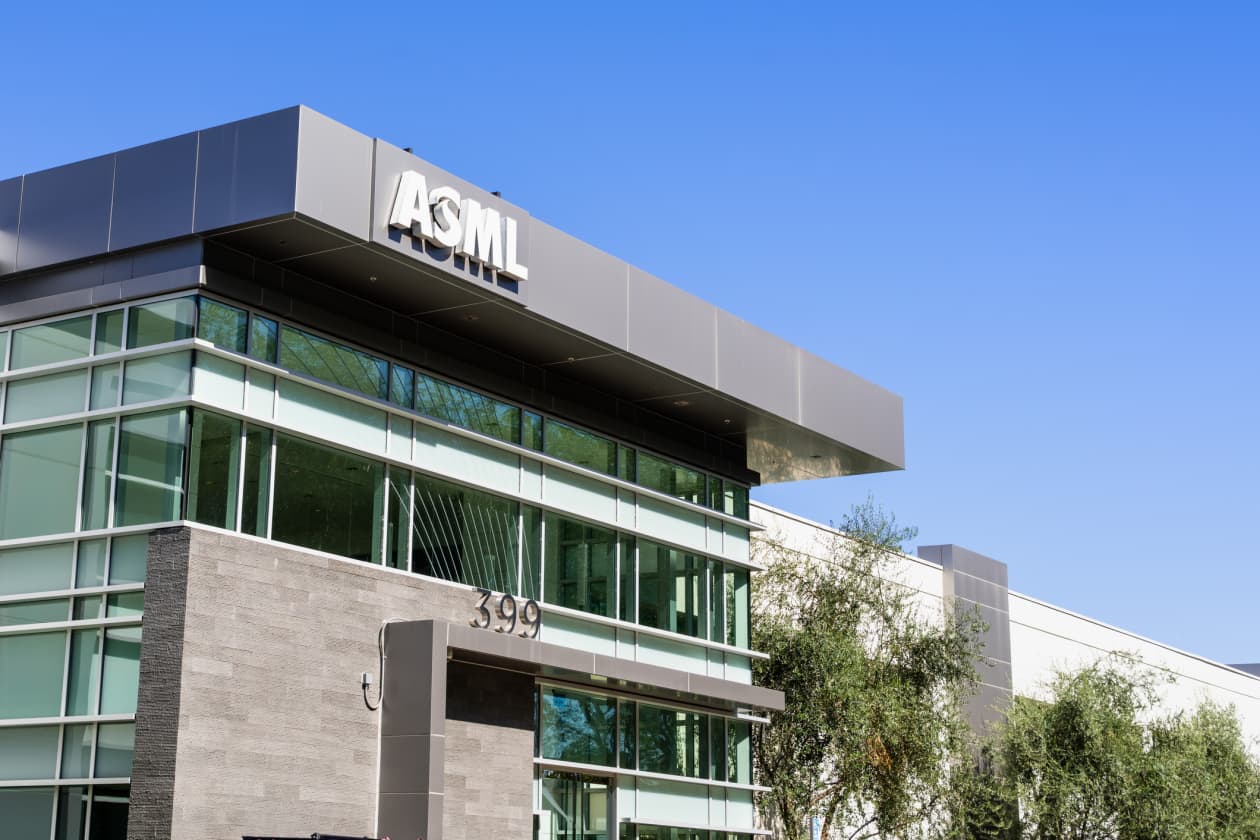
ASML raised its 2026 revenue outlook to €36 billion-€40 billion from €34 billion-€39 billion after a strong first quarter, lifting the midpoint by about 4%. CEO Christophe Fouquet said demand will outstrip supply for the foreseeable future, underscoring continued strength in the company’s fundamentals. The beat-and-raise setup is likely to support the stock and may modestly lift sentiment across semiconductor equipment names.
The key second-order effect is that ASML’s tighter supply outlook is not just a story about its own backlog; it is a constraint on the entire semiconductor capacity expansion cycle. If EUV and high-NA tool deliveries remain bottlenecked, foundries and memory players may have to defer the most advanced node ramps, which pushes out revenue recognition for the ecosystem even if demand remains intact. That tends to widen the gap between “design wins” and actual wafer output, a setup that usually favors the toolmaker with pricing power and hurts peers exposed to order timing risk. This also changes bargaining dynamics downstream: customers facing scarce tool supply are more likely to lock in multi-quarter commitments and accept higher service and upgrade spend to secure installation slots. The beneficiary set is broader than the obvious name—metrology, specialty components, and consumables vendors with ASML-linked content should see better visibility, while fabs with the weakest balance sheets face the most working-capital strain as they prepay to preserve queue position. The market may underappreciate that a supply-constrained ASML can actually accelerate margin divergence across the semi capex chain rather than just lifting one stock. The main risk is not demand collapse, but a sequencing problem: if ASML’s capacity expansion or customer qualification slips by even one to two quarters, the near-term upside in estimates can get pulled forward while the eventual execution risk gets pushed out. A second-order negative is that persistent scarcity can invite political scrutiny around export controls and industrial policy, which could cap the multiple if investors start pricing in regulatory friction rather than pure scarcity value. Over a 6-12 month horizon, the trade remains supported unless end-market orders roll over, but over 12-24 months the market will focus on whether this is sustainable pricing power or simply a temporary choke point. The contrarian view is that consensus may be too anchored on the headline guide raise and not enough on elasticity: if customers start rephasing capex to match tool availability, reported demand can look stronger than true incremental demand. In that case, the stock can continue to work, but the adjacent semi equipment names with less structural scarcity could be the better risk/reward. The cleanest read-through is that ASML is the tollbooth, not the whole highway—own the constrained asset, but be selective about the rest of the value chain.
AI-powered research, real-time alerts, and portfolio analytics for institutional investors.
Request a DemoOverall Sentiment
strongly positive
Sentiment Score
0.72
Ticker Sentiment
