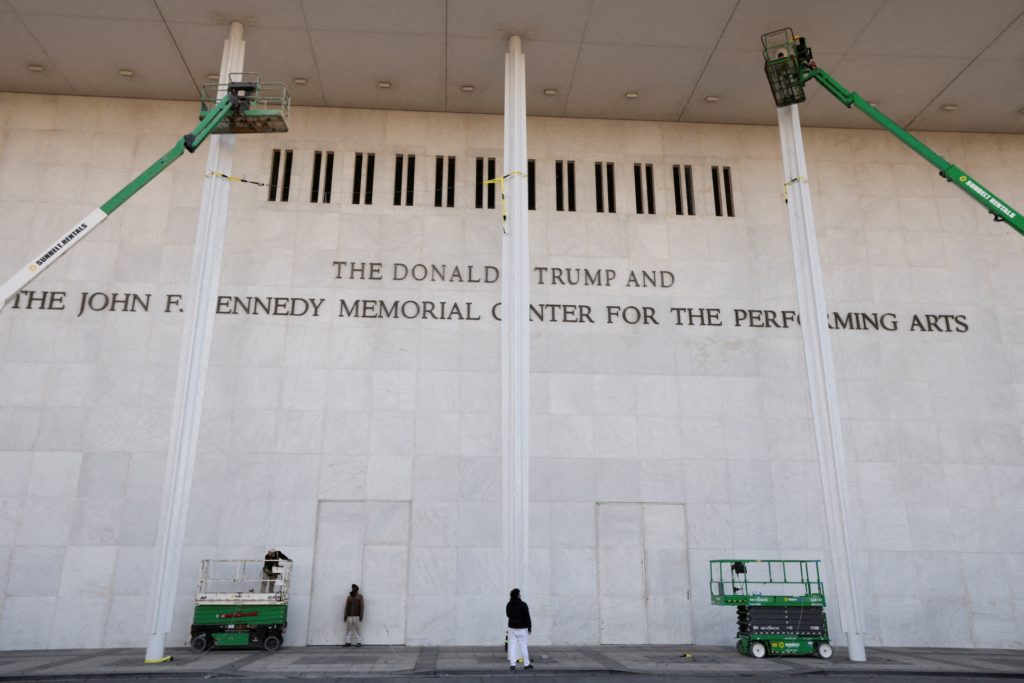
A federal judge ordered the Kennedy Center to remove Donald Trump’s name from the building, adding another legal setback for the administration. The report also highlighted ongoing U.S.-Iran negotiations, Israeli advances in Lebanon, and Romania’s confirmation of a Russian drone crash on NATO soil that injured several people. Overall the piece is a broad news wrap with limited direct market implications, though the geopolitical developments are notable.
The cleanest market read is not on the headlines themselves but on institutional drift: multiple legal and political setbacks are increasing the probability that some Trump-era policy proposals get slowed, diluted, or re-routed through more cumbersome channels. That matters for domestic policy beta because uncertainty extends the timeline for implementation, which tends to favor market structures that monetize activity and volatility rather than discrete policy outcomes. The bigger second-order effect is that Washington is becoming a more contested venue for budgetary and regulatory execution, which raises the option value of firms that can arbitrage compliance complexity, but also raises headline risk for anything tied to enforcement or government contracting. ICE looks modestly impaired because immigration crackdowns are where legal risk translates most directly into operational friction: tighter scrutiny on agents, higher litigation costs, and more caution around field actions can slow activity volumes and compress utilization around the edges. This is not a thesis killer for the franchise, but it does create a mismatch between political rhetoric and on-the-ground throughput that the market can underappreciate over the next 1-3 quarters. The more interesting tell is that if enforcement is forced to become procedurally slower, the beneficiaries are adjacent legal, monitoring, and detention-adjacent service providers rather than headline enforcement names. NDAQ is the cleaner beneficiary because records and volatility are being repriced upward across equity markets: governance disputes, election-related redistricting fights, and geopolitics all increase hedging demand, turnover, and listings/derivatives engagement. A persistently elevated tape is supportive for transaction-sensitive revenue, and the current environment also raises the odds of more capital-markets activity as issuers seek to fund around policy and geopolitical uncertainty. The risk is that if legal/political shocks settle without broader market volatility, the boost to trading volumes fades quickly and the multiple expansion thesis becomes overstretched. Consensus is probably underestimating how asymmetric this is for NDAQ versus ICE: market volatility is a repeatable monetization engine, while enforcement-related policy noise is often a one-off headline event that does not necessarily improve ICE's economics. The overreaction risk is on the downside for ICE if investors extrapolate one enforcement case into a broader operational hit, but the better trade is still to prefer the asset-light volatility monetizers over names whose revenues depend on politically sensitive field execution. Duration matters: NDAQ can benefit over months; ICE is more event-driven and likely to mean-revert faster unless legal pressure compounds.
AI-powered research, real-time alerts, and portfolio analytics for institutional investors.
Request a DemoOverall Sentiment
neutral
Sentiment Score
-0.05
Ticker Sentiment
