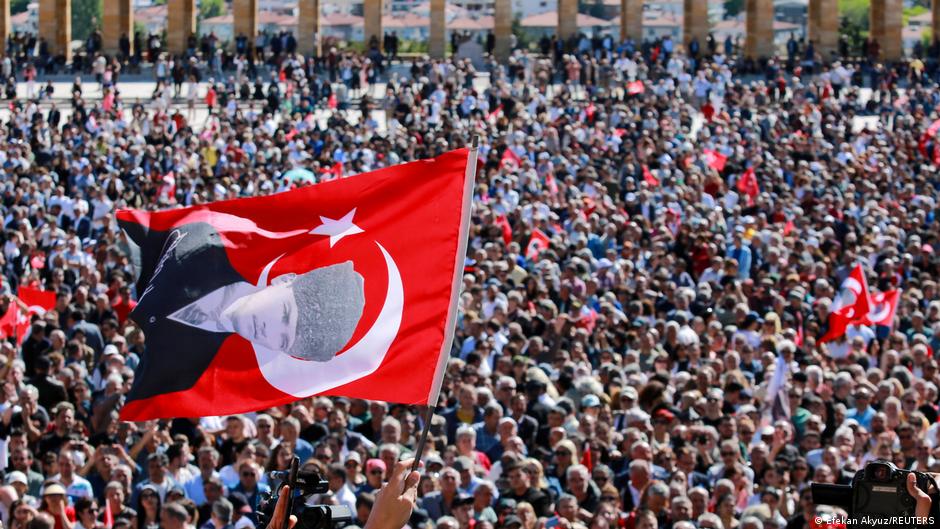
Thousands marched in Ankara to back CHP leader Ozgur Ozel after a court invalidated the party's 2023 congress and provisionally reinstated former leader Kemal Kilicdaroglu. The dispute has intensified concerns that the ruling is politically motivated and could weaken Turkey's main opposition ahead of the 2028 presidential election. Former Istanbul mayor Ekrem Imamoglu remains jailed, underscoring the broader clampdown on the CHP.
This is less an intra-party quarrel than a live stress test of Turkey’s institutional discount. The market implication is not the headline rally itself, but the signaling that the opposition’s succession path is now subject to judicial override, which raises the probability that any 2028 alternative to Erdogan gets procedurally kneecapped well before votes are cast. That tends to widen the risk premium on Turkish assets via a higher perceived odds of policy continuity, weaker checks on executive power, and more abrupt shifts in capital controls or regulatory enforcement if political pressure intensifies. The second-order effect is on foreign ownership behavior: global allocators who can tolerate carry may still own local duration, but they are more likely to reduce equity beta and shorten holding periods because governance risk is becoming idiosyncratic rather than macro. That is typically bearish for domestically oriented banks, brokers, and consumer names that depend on stable rule-of-law expectations and benign funding conditions. Exporters with hard-currency revenue are comparatively insulated, and any renewed lira weakness can actually improve their translated earnings, though only if they avoid domestic input-cost pass-through. The near-term catalyst stack is legal, not electoral: additional court rulings, forced congress timing, and any escalation around opposition figures over the next 2-8 weeks will matter more than polling. The tail risk is a disorderly confidence shock if the dispute broadens into protests or a wider crackdown, which could pressure the lira, local rates, and bank funding access within days. What could reverse it is a negotiated party reset that restores a credible opposition path and reduces the perception of arbitrary legal intervention. Consensus is probably underpricing how much this hurts the long-duration Turkey re-rating story. Even if the macro data improve, investors pay up for EMs when institutional legitimacy looks durable; once that premise breaks, growth surprises matter less than governance fragility. The more interesting trade is not a blanket short Turkey, but selective expression through domestic equities versus dollar earners and via FX vol rather than spot alone.
AI-powered research, real-time alerts, and portfolio analytics for institutional investors.
Request a DemoOverall Sentiment
mildly negative
Sentiment Score
-0.15
